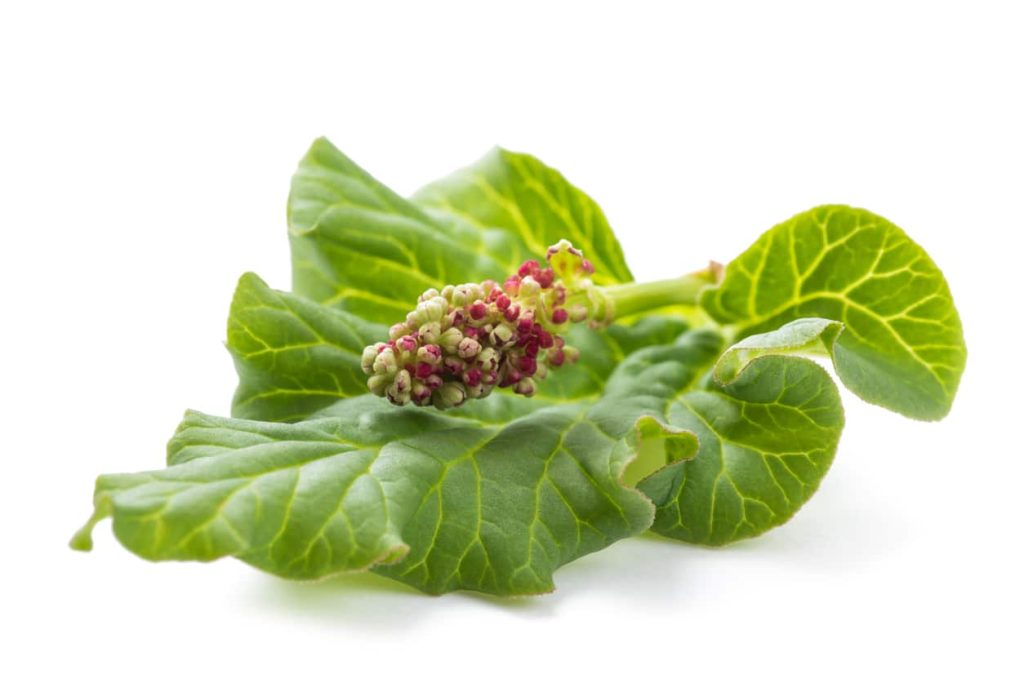
Rheum palmatum (Chinese rhubarb) is a clump-forming perennial grown primarily for its huge dark green leaves. It looks great as an accent plant around borders or near streams and ponds. However, did you know, its role has been medicinal rather than culinary during most of its period of use. Medicinally, rhubarb dates back more than 5,000 years ago, compared to its culinary use of only two centuries ago. Due to the trade between Venice and the Orient, rhubarb was brought to Europe and used medicinally at the beginning of the 17th century.
Parts Used- In herbal medicine, it’s the roots that are used, not the stems and leaves. As the leaves are poisonous, they should not be consumed or given to animals. In herbal medicine, the dried roots are ground down into a yellowish-orange powder.
Dosage- The World Health Organisation recommends between 10-20 mg of anthracene derivatives (the active ingredients) per dose.
Traditionally, Rhubarb is said to be effective in reducing toxicity resulting from the overconsumption of meat. It is known as a sour, astringent and cooling food that helps remove toxins and heat; it also supports healthy blood circulation. Due to its cooling properties, in traditional medicine, it is known as an excellent food to help cool an inflamed liver for detoxification after eating too much rich food.
The traditional use of rhubarb has been as a laxative to relieve constipation and as a purgative. Other proposed uses of the plant are as follows;
Prevents the progression of chronic renal failure in those with high serum creatinine.
Due to the high fibre content, rhubarb has a lipid-lowering effect.
As I mentioned, in TCM, rhubarb also belongs to the ‘purgative herbs that drain downward’, herbs that belong to this category are used to treat constipation. Purgatives work by removing Excess Heat in the intestines and/or stomach. In TCM, all herbs within this category are cold, and we know the theory that cold reduces heat. As rhubarb is cold in nature, typically, herbalists will use it for people with too much Heat present in their system.
Chinese Medicine also works on the theory that the taste of herbs/foods determines their action on the body. Rhubarb is bitter, once again, meaning it tends to have a cleansing action on the body. This occurs by clearing Heat, drying Dampness, and providing elimination via urination or bowel movements.
Diabetes is the number one cause of kidney disease; it is present in almost 43.8% of all cases. Apart from being a major risk factor for cardiovascular disease, metabolic syndrome has been associated with an increased risk of chronic kidney disease.
The basic components that make up metabolic syndrome are hypertension, obesity, type 2 diabetes Mellitus and low-high-density lipoproteins. The cluster of symptoms increases the risk of heart disease, stroke and type 2 diabetes. It doesn’t mean you have metabolic syndrome if you have one of these symptoms; however, it does mean you may have a greater risk of serious disease.
Symptoms
Metabolic syndrome may not necessarily have obvious signs or symptoms. One sign that is obvious is an increase in waist circumference. If your blood sugar levels are high you may notice the signs and symptoms associated with diabetes, such as an increase in thirst, urination, fatigue and blurred vision.
Several epidemiologic studies conducted suggest that insulin resistance, as well as compensatory hyperinsulinemia, are both independently associated with an increased risk of chronic kidney disease. Studies also support the presence of several pathways linking insulin resistance and hyperinsulinemia with kidney damage. Insulin resistance and hyperinsulinemia are associated with decreased endothelial production of nitric oxide and an increase in oxidative stress, which is also implicated in diabetic nephropathy progression.
Compensatory increases in plasma insulin, when insulin resistance becomes worse, have been found to trigger mechanisms that will directly or indirectly increase renal sodium reabsorption and will also impact sympathetic nervous system activity. If this continues to occur, these changes can lead to an increase in blood pressure, leading to hypertension in patients with metabolic syndrome. Studies have also shown that hyperinsulinemia can contribute to hypertension. It has been shown that insulin can have an antinatriuresis effect. These studies support the hypothesis that acute hyperinsulinemia can stimulate renal tubular sodium absorption, and if this continues will lead to an increase in blood pressure.
Insulin Resistance and Kidney Disease: Hyperinsulinemia
Rhubarb contains anthraquinones, rhein, emodin and aloe-emodin. It is these derivatives that support the elimination of nitrogenous products through the alimentary system and the regulation of water and electrolyte metabolism.
The treatment for CKD-ESRD (end-stage renal disease) is renal replacement therapy, which includes renal transplantation and dialysis. As this is costly, requires lifelong care, and is not suitable for many, with many complications, conservative therapy is employed instead.
A 2014 randomised clinical trial evaluated the efficacy and safety of the use of rhubarb in patients with CKD. The study was conducted on patients with CKD stages 3 and 4. Patients were randomly divided into two groups; Group 1 (Control) received conservative management, whilst Group II (Rhubarb) received conservative treatment along with a Rhubarb capsule (350mg, thrice daily) for the duration of 12 weeks.
Renal function tests and haemogram were measured at 0, 4, 8 and 12 weeks of treatment. The authors found clinical features were improved in both groups by week 12; however, the rhubarb group showed a marked improvement compared to the control group. Both groups also showed a gradual improvement in biochemical parameters, once again a marked improvement in the rhubarb group. The authors found there was a reduction in blood glucose levels, blood urea, 24-hour total urine protein and serum creatinine. There was an increase in haemoglobin, 24-hour total urine volume and glomerular filtration rate. They concluded that rhubarb supplementation improved the therapeutic effect of conservative management in stages 3 and 4 of CKD.
In another study, the authors studied the effects of integrating Chinese and Western medicine with rhubarb as the main medicine. Sixty hospitalised patients were divided into two groups: an integrated Chinese and Western medicine group (Test group, 30 patients) and a Western medicine group (30 patients, Control group). Both groups were treated for three weeks. Results showed that levels of blood urea nitrogen and serum creatinine after treatment were higher than before the treatment in the control group. Lower in the test group. The study concluded that integrated Chinese and Western medicine using Rhubarb as the main choice of therapy can delay renal function deterioration and also improve renal function in some cases.
As rhubarb has a strong cathartic effect, it has been thought to increase the excretion of waste products in the body, this includes the nitrogenous waste which is accumulated in those with renal failure, via the intestines. The anthraquinones emodin and rhein play a role in regulating inflammation and the immune response. In animal studies, emodin and rhein have been shown to decrease proteinuria and glomerulosclerosis. Other clinical studies have shown as well as reducing proteinuria and improving renal function, rhubarb may cause a further reduction of proteinuria and improved renal function when combined with angiotensin-converting enzyme inhibitors.
As you can see, rhubarb shows a lot of potential in supporting patients with kidney disease. The traditional use of rhubarb also offers a very different perspective on its use and its actions, which is well worth considering!
I hope you found this article helpful.
Please remember, as with any dietary/ supplemental change in those with a chronic health concern, to make sure you consult your health professional first.
Feel free to share this article with friends and family, or head over to our Facebook page and leave us a comment.
Oxytocin is often called the ‘love hormone’ because of its well-known role in childbirth, breastfeeding, and emotional bonding. But emerging research reveals this remarkable hormone does far more than foster maternal connection. Scientists are now discovering that oxytocin plays a crucial role in kidney function and may offer significant protective benefits for people with chronic…
The Urgency of Kidney Health Chronic kidney disease (CKD) is one of the fastest-growing health concerns worldwide, affecting an estimated 10% of the population. The kidneys are essential for maintaining fluid balance, regulating blood pressure, detoxifying the body, and producing hormones. Once kidney function declines, recovery is difficult and often limited. Prevention, early support, and…
Protect your kidneys while fighting infections – learn the essential strategies every CKD patient needs to know about antibiotic safety. Why Antibiotics Can Be Dangerous for Kidney Patients Antibiotics have revolutionized modern medicine, transforming previously fatal bacterial infections into treatable conditions. However, for the millions of Americans living with chronic kidney disease (CKD), these life-saving…

 By Libby Shaw